3月8日,《中国日报》头版刊发全国人大代表,云南省委书记、省人大常委会主任王宁专访文章,欢迎全球朋友来云南体验“有一种叫云南的生活”。
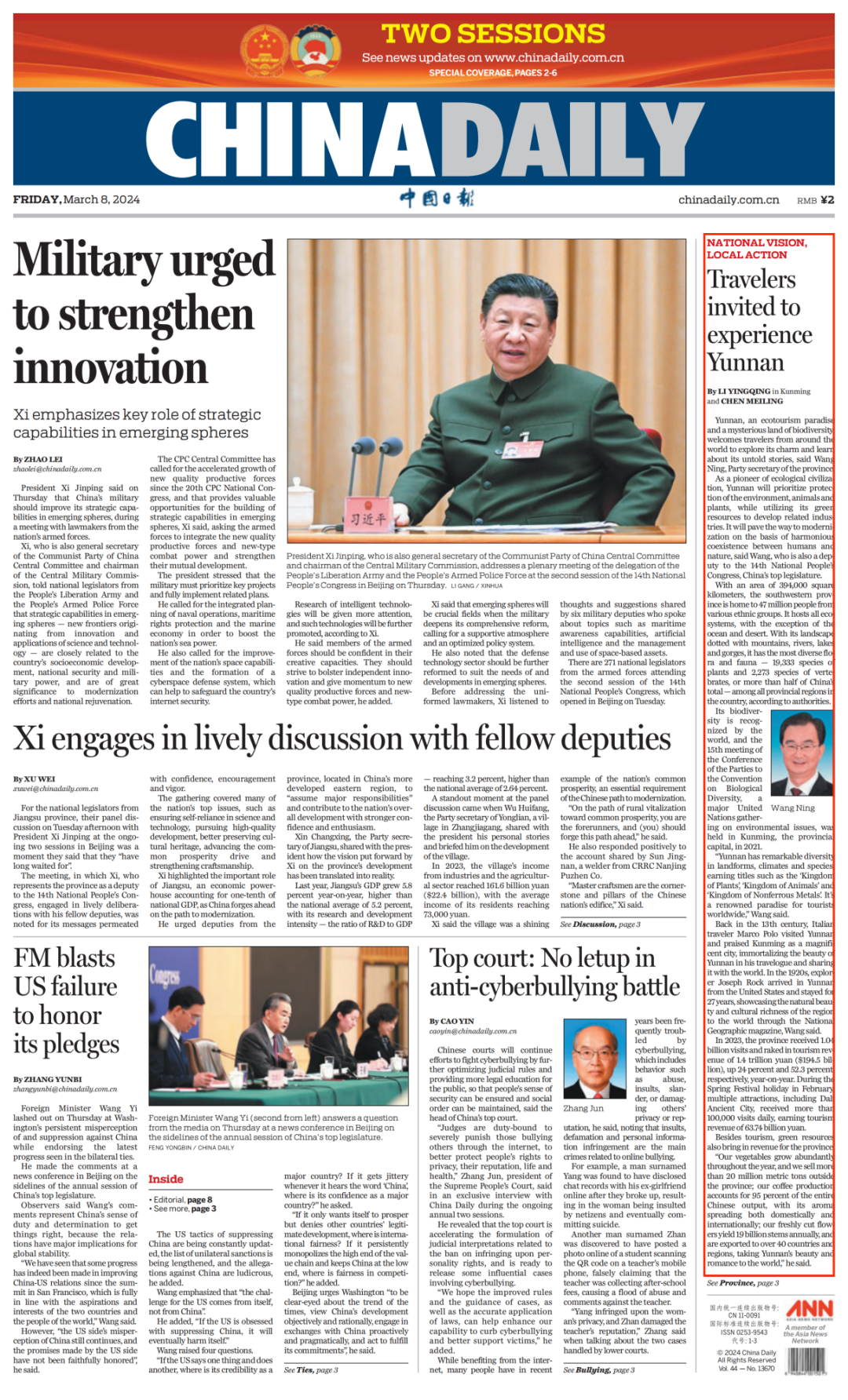
Yunnan, an ecotourism paradise and a mysterious land of biodiversity, welcomes travelers from around the world to explore its charm and learn about its untold stories, said Wang Ning, Party secretary of the province.
As a pioneer of ecological civilization, Yunnan will prioritize protection of the environment, animals and plants, while utilizing its green resources to develop related industries. It will pave the way to modernization on the basis of harmonious coexistence between humans and nature, said Wang, who is also a deputy to the 14th National People's Congress, China's top legislature.
With an area of 394,000 square kilometers, the southwestern province is home to 47 million people from various ethnic groups. It hosts all ecosystems, with the exception of the ocean and desert. With its landscape dotted with mountains, rivers, lakes and gorges, it has the most diverse flora and fauna — 19,333 species of plants and 2,273 species of vertebrates, or more than half of China's total — among all provincial regions in the country, according to authorities.
Its biodiversity is recognized by the world, and the 15th meeting of the Conference of the Parties to the Convention on Biological Diversity, a major United Nations gathering on environmental issues, was held in Kunming in 2021.
"Yunnan has remarkable diversity in landforms, climates and species, earning titles such as the 'Kingdom of Plants', 'Kingdom of Animals' and 'Kingdom of Nonferrous Metals'. It's a renowned paradise for tourists worldwide," Wang said.
Back in the 13th century, Italian traveler Marco Polo visited Yunnan and praised Kunming, its capital, as a magnificent city, immortalizing the beauty of Yunnan in his travelogue and sharing it with the world. In the 1920s, explorer Joseph Rock arrived in Yunnan from the United States and stayed for 27 years, showcasing the natural beauty and cultural richness of the region to the world through the National Geographic magazine, according to Wang.
In 2023, the province received 1.04 billion visits and raked in tourism revenue of 1.4 trillion yuan ($194.5 billion), up 24 percent and 52.3 percent, respectively, year-on-year. During the Spring Festival holiday in February, multiple attractions, including Dali Ancient City, welcomed more than 100,000 visits daily, earning tourism revenue of 63.74 billion yuan.
Besides tourism, green resources also bring in revenue for the province.
"Our vegetables grow abundantly throughout the year, and we sell more than 20 million metric tons outside the province; our coffee production accounts for 95 percent of the entire Chinese output, with its aroma spreading both domestically and internationally; our freshly cut flowers yield 19 billion stems annually, and are exported to over 40 countries and regions, taking Yunnan's beauty and romance to the world," he said.
Wang added that the ecological environment is a precious asset of Yunnan, serving as a solid foundation for accelerating development and catching up.
"To prioritize the ecological environment is to secure the sustainable development of Yunnan and to ensure the well-being of future generations," he said.
Yunnan will promote the integrated protection and comprehensive management of mountains, rivers, forests, farmlands, lakes and grasslands, ensuring that "no ecological environment is damaged no matter how small it is, and ecological conservation will not yield to economic interests", he said.
The province will control and reduce air, water and soil pollution to benefit the environment. It will promote green transformation of companies to improve the efficiency of resource and energy utilization and reduce emissions. Yunnan will focus on major agriculture-based industries such as tea, fresh flowers, vegetables, fruits, nuts and coffee, and develop high-quality agricultural brands, Wang said.
The province will also be innovative in development of ecological tourism by putting forward themed routes such as Asian elephants, snub-nosed monkeys, black-necked cranes, the Yuanyang terraced fields and old tea forests of the Jingmai Mountain. It will promote the conservation and utilization of biological resources to develop biopharmaceutical industry, he added.
译文如下
↓↓↓
云南省是生态旅游的天堂,也是生物多样性的神秘王国。全国人大代表,云南省委书记、省人大常委会主任王宁表示,欢迎全球朋友来云南体验“有一种叫云南的生活”,探索云南秘境,了解它不为人知的故事。
王宁说,作为生态文明建设的先行者,云南将优先保护自然环境、动植物,同时利用其绿色资源发展产业,在人与自然和谐共生的基础上,走上现代化道路。
七彩云南、如诗如画,全省面积39.4万平方公里,生活着4700万纯朴善良、热情好客的各族人民。云南拥有除了海洋和沙漠之外的所有生态系统。云南拥有多样的山脉、河流、高原湖泊、雪山和峡谷景观,是中国拥有最丰富生物多样性资源的地区——共有19,333种植物和2,273种脊椎动物,占据了全国物种数量的一半以上。这里资源富集,具有地貌多样性、气候多样性、物种多样性等显著特点,是名副其实的“植物王国”“动物王国”和“有色金属王国”,他说。
王宁表示,早在13世纪,意大利旅行家马可·波罗就到过云南,赞叹昆明是一座壮丽大城,把云南的美写进了游记、告诉了世界;上世纪20年代,美国探险家洛克来到云南,一住27年,通过《国家地理》杂志,向世人展示了云南的自然之美、人文之美。
2021年,COP15大会在云南举办,15头亚洲象北上南归,这段人象和谐的神奇之旅,温暖了全世界。这样的场景,在云南还有很多。
“去年3月,我向大家推介了‘有一种叫云南的生活’,全网阅读量超过260亿次,云南多次‘上分’”,王宁说。
2023年云南省接待游客10.4亿人次、旅游总收入1.4万亿元,分别增长24%、52.3%。今年春节假期期间,昆明滇池大坝、大理古城等多个景区的游客量多日超10万人次,据抽样调查,省外游客占比达54.3%。
除了旅游,绿色资源也推动了云南的产业发展。
“我们的蔬菜一年四季丰产,年外销超过2000万吨;我们的咖啡产量占全中国的95%以上,香飘海内外;我们的鲜切花年产190亿枝,出口40多个国家和地区,全球平均人手2枝,为世界贡献了云南的美和浪漫”,他说。
王宁说,生态环境是云南的宝贵财富,是云南加快发展、后来居上的坚实基础。抓生态环境就是抓云南的永续发展,就是抓子孙后代的民生福祉。
云南将推进山水林田湖草沙一体化保护和系统治理,做到在保护面前,生态环境再小不破坏,经济利益再大不动摇。
王宁表示,云南将要持续深入打好蓝天、碧水、净土三大攻坚战,让七彩云南的天更蓝、山更绿、水更清、景更美。将加快发展方式绿色转型,把资源能源利用效率提上去,把排放强度降下来,实现经济社会发展和生态环境保护协调统一。云南将切实抓好生物资源保护与利用,既要守护好“生物多样性宝库”,也要推进高效益开发利用,把生物资源优势转化为绿色发展优势。
聚焦茶叶、鲜花、蔬菜、水果、坚果、咖啡等重点产业,打造高端高品质的农业品牌,让绿色“云品”成为云南农业的“金名片”。
与此同时,云南将大力发展生态绿色旅游,围绕亚洲象、滇金丝猴、黑颈鹤、元阳梯田、景迈山古茶林等主题,谋划推出一批生态游精品线路。
“人与自然相生相伴、保护与馈赠,正是‘有一种叫云南的生活’最鲜艳的绿色主题”,王宁说。
 滇公网安备 53011402000434号


